The recurring request
Calls for a European provisional patent application are not new. A 2002 European Commission communication recorded strong support from large industry, while academic respondents also attached considerable importance to the idea.[1] At a 2014 EPO workshop, several discussion groups asked whether a cheap, easily prepared provisional filing might help researchers under pressure to publish.[2]
The same workshop recorded the objection that matters most before the EPO. One practitioner warned that the EPO’s strict approach to the identity of the invention made hastily drafted provisional applications “problematic and dangerous”: without a clear and unambiguous disclosure, the later European application might not validly claim priority.[3]
The paradox is that applicants already have the full practical functionality usually sought from a provisional filing. An ordinary EP application can be filed entirely electronically, secure a filing date under light formal requirements and then lapse. Its certified priority document can likewise be requested and delivered electronically. If the filing and search fees are not paid and the priority document is requested through MyEPO, the official-fee total is currently EUR 0. What Europe does not offer – and should not import casually – is an assurance that a rough first draft can safely be repaired twelve months later.
First establish what was filed
The EPO’s new electronic priority document establishes the evidential starting point unusually well. Its embedded electronic seal identifies the EPO as issuer. Its certification PDF states a SHA-256 digest of the substantive archive. Recalculating that digest confirms that the archive being examined is exactly the archive certified by the EPO.
The complete verification has three stages: validate the seal on signature.pdf; compare its stated digest with a digest calculated over the inner certified-copy.zip; and inspect priority_documents.pdf to see the application number, filing date and application as filed. Figure 1 summarises the chain.
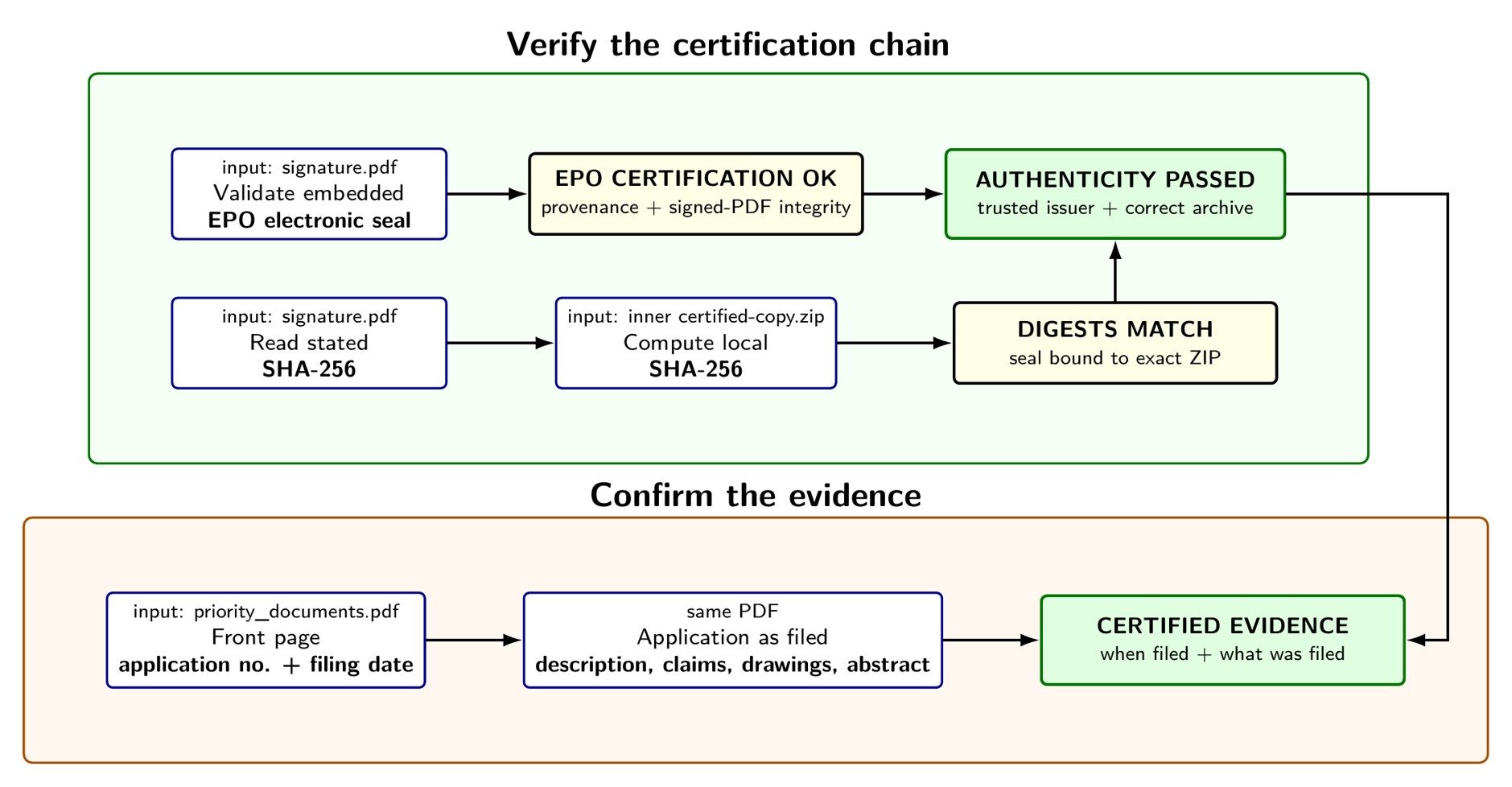
Figure 1. The verification chain: validate the EPO seal, match the stated and calculated SHA-256 values, then inspect the certified application content.
This can prove exactly what was filed. It cannot prove that the filing disclosed enough.
Already available in everything but name
The EPC does not define a separate provisional application. Nevertheless, Rule 40 allows a European application to receive a filing date if the filed material indicates that a European patent is sought, identifies the applicant and contains a description or a reference to a previous application. Claims are not required merely to obtain that date.[4]
If the filing and search fees are not paid within one month, the application is deemed withdrawn, but its filing date is not undone. Article 87(3) EPC treats a filing as regular if it establishes a filing date, whatever its later outcome. An EP application may therefore serve as the first filing and then lapse.[5]
Taken together, electronic filing, a priority-establishing filing date, no need to pursue the application, electronic delivery of the certified priority document and a zero-official-fee route amount to a fully electronic European provisional in everything but name. This is not a recommendation to file an improvised disclosure. An application intended to die may still determine whether a commercially important priority survives. Saving official fees while underinvesting in the disclosure is an exceptionally poor economy.
Where the US analogy becomes dangerous
Even a US provisional supports only the subject matter it actually discloses.[6] The danger becomes particularly acute before the EPO because the “same invention” test for priority is the same basic test used for added subject matter under Article 123(2) EPC. The later-claimed subject matter must be directly and unambiguously derivable from the priority application as a whole.[7]
A rushed filing may describe one narrow embodiment but omit alternatives, ranges, combinations or general teaching. The later EP or PCT application can contain the missing material, but that material does not acquire the earlier date. A later attempt to generalise from the narrow example may also create an intermediate-generalisation problem. Depending on the claim, priority may fail wholly or partly, allowing an intervening publication – sometimes the applicant’s own – to become prior art.
The practical lesson is deliberately unexciting: if an early filing may become the basis for European priority, it should be drafted as a serious technical disclosure. “Provisional” may describe its intended lifetime. It should not describe the quality of its contents.
Changing the label would change little
Creating a statutory European provisional category without changing the substantive priority test would add a convenient label and perhaps administrative simplifications. It would not make a thin disclosure safer: Europe already supplies the basic procedural result through an ordinary EP filing.
To make US-style behaviour safer, reform would have to relax the requirement that the later claim be directly and unambiguously derivable from the first filing, or tolerate subject matter developed during the priority year. That would alter the boundary between valid priority, added subject matter and intervening prior art.
That might give applicants flexibility, but at a cost to legal certainty for third parties determining what date a claim enjoys. The Commission consultation and EPO workshop show both sides. The strict European answer can be unforgiving, but changing it is not necessarily a good idea.
Europe therefore already has a functional provisional filing. What it does not have is a reliable way to treat the first application as a placeholder that can be substantively rewritten later. Before the EPO, that difference is the whole point.
[1] European Commission, COM(2002) 2 final, section 3.2.2.
[2] EPO Economic and Scientific Advisory Board, The economic effects of introducing a grace period in Europe, workshop report (2015), section 2.5, p. 11 of the report.
[3] EPO Economic and Scientific Advisory Board, The economic effects of introducing a grace period in Europe, workshop report (2015), section 2.5, p. 11 of the report.
[4] Rule 40 EPC; EPO Guidelines for Examination, A-II, 4.1.
[5] Rule 38 EPC; Article 87(3) EPC; EPO, OJ EPO 2025, A7, point 6.
[6] USPTO, MPEP § 211.
[7] EPO Guidelines for Examination, F-VI, 2.2 and H-IV, 2.2.