AIPPI IP & GRTK Committee Webinar
14 September 2026 - 14 September 2026 | Webinar | AIPPI
The panel will discuss Digital Sequence Information (DSI), which broadly refers to digital data derived from the genetic material of plants, animals, microorganisms, and other organisms, having become one of the most significant and rapidly evolving topics at the intersection of biodiversity, intellectual property and innovation policy.
As governments continue to develop an international framework for benefit-sharing related to DSI, important questions arise regarding its interaction with the patent system, including the recently adopted WIPO Treaty on Intellectual Property, Genetic Resources and Associated Traditional Knowledge and its new patent disclosure requirement.
In parallel, the establishment of the Cali Fund represents the first global financial mechanism specifically intended to facilitate benefit-sharing arising from the use of DSI. Discussions on the operationalization of this mechanism – and the broader governance of DSI – are expected to remain a central topic at CBD COP17, scheduled to take place in Armenia in October 2026.
These developments have significant implications for innovators, patent practitioners, policymakers and companies, especially those operating in the life sciences and biotechnology sectors.
Against this background, the webinar aims to provide a practical understanding of the evolving DSI landscape, bringing together its key biodiversity, benefit-sharing and intellectual property dimensions.
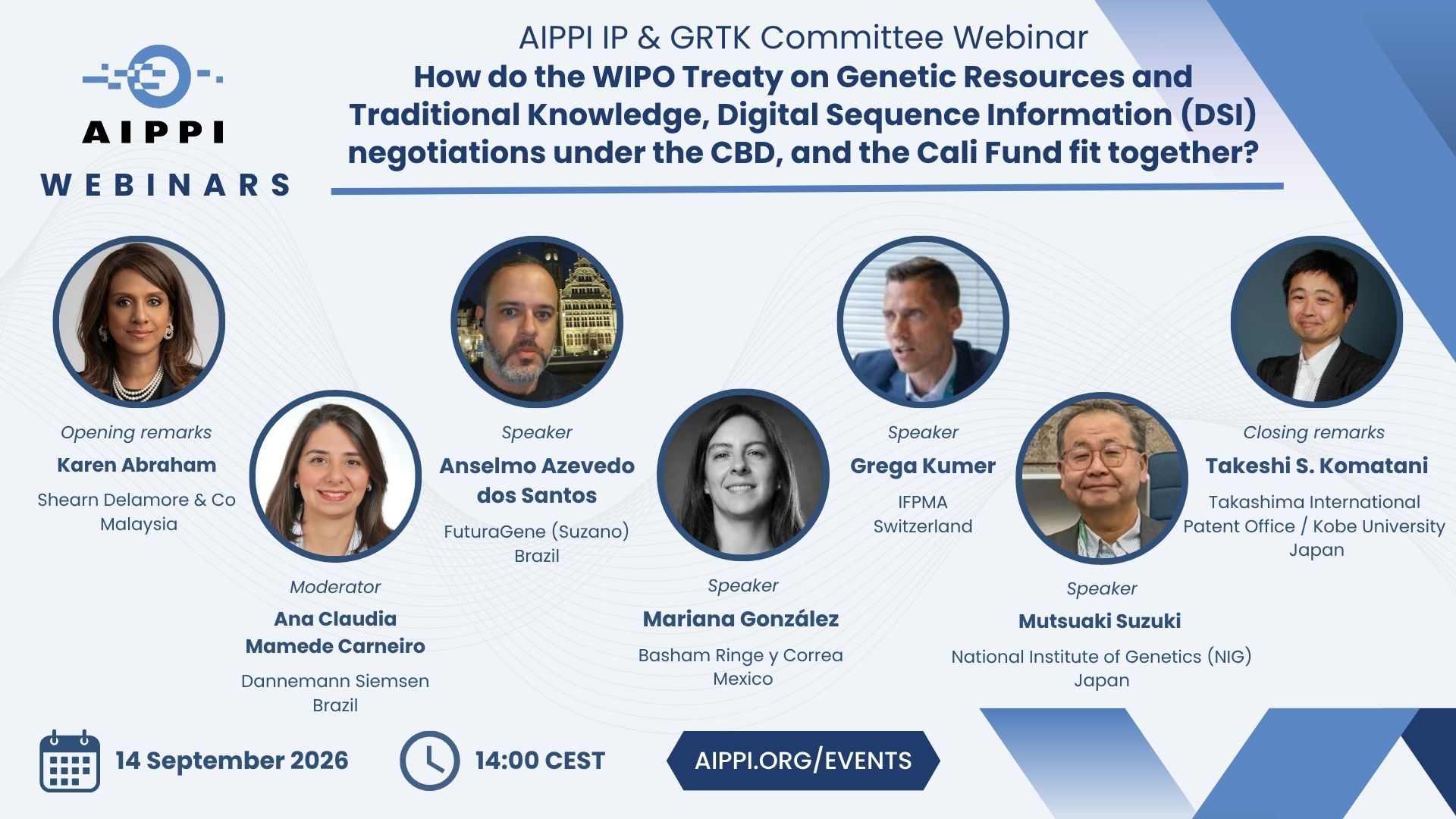
Karen Abraham, Shearn Delamore & Co, Malaysia
Chair of the Standing Committee on IP & GRTK for AIPPI
Ana Claudia Mamede Carneiro, Dannemann Siemsen, Brazil
Ana Claudia Mamede Carneiro is Partner with Dannemann Siemsen, IP Agent and Chemical Engineer. She is a patent prosecutor and provides technical assistance in patent infringement and nullity court actions in life sciences and chemical fields over 30 years. She is member of the AIPPI Pharma & Biotech Committee and AIPPI IP & Genetic Resources, Traditional Knowledge and Traditional Culture Expressions Committee.
Anselmo Azevedo dos Santos, FuturaGene (Suzano), Brazil
Anselmo Azevedo dos Santos is a biologist, M.Sc. in Genetics and Plant Breeding, and Ph.D. candidate in Molecular Biology, currently working as a Regulatory Affairs Consultant at FuturaGene (Suzano SA). With extensive experience in biotechnology, genomics, and GMO risk assessment, he specializes in the nexus between science, biological data governance, and global policy. He actively contributes to multilateral forums under the Convention on Biological Diversity (CBD), focusing on Digital Sequence Information (DSI), benefit-sharing mechanisms, and Decision 16/2 implementation.
Mariana González, Basham Ringe y Correa, Mexico,
Mariana Gonzalez, partner at Basham, Ringe y Correa, has over 17 years of experience in patent prosecution, IP transactions, and litigation, particularly in the life sciences sector. With degrees in chemistry and law, a master’s in top management, and the Certified Licensing Professional® credential, Mariana offers integrated scientific and legal expertise. A recognized authority on Mexico’s linkage system and data exclusivity, Mariana also has research experience, including a stay at Ohio State University focusing on DNA base characterization through ultrafast laser spectroscopy. Mariana has acted as an expert witness in significant pharmaceutical litigations, contributing expert opinions in complex cases. Author and co-author of several articles and publications.
Grega Kumer, IFPMA, Switzerland
Grega Kumer is Deputy Director, Government Relations of IFPMA. He leads advocacy and engagement with governments involved in multilateral organizations and is the liaison between IFPMA and its member associations. He is responsible for industry work on the Convention on Biodiversity and Nagoya Protocol. Before joining IFPMA, Grega managed the IP portfolio at the UK Mission in Geneva and, prior to that, was the Deputy Permanent Representative to the WTO and served as WIPO Regional Coordinator for Central European and Baltic states. In addition, he has worked as a legal advisor to a start-up company with focus on protection of IP rights. Grega holds a Master of Law (LLM) from London Metropolitan University. He has also completed an Executive Course in Global Health Diplomacy at the Graduate Institute of International and Development Studies in Geneva and WIPO Summer School on IP Law at the University of Geneva.
Mutsuaki Suzuki, National Institute of Genetics (NIG), Japan
Dr Mutsumi Suzuki is Head of the ABS Support Office at the Research and Innovation Bridge Centre of the National Institute of Genetics (NIG). He leads Japan’s National Support Team, which advises academic researchers on Access and Benefit-sharing (ABS) and compliance with the Nagoya Protocol. Since 2012, he has participated in negotiations under the Convention on Biological Diversity (CBD) as a member of the Japanese government delegation, and has recently been involved in discussions on digital sequence information (DSI), the Multilateral Mechanism and the Kari Fund. His work serves as a bridge between public sequence databases, such as DDBJ/INSDC, and international biodiversity policy. He is also the founder and Secretary-General of the Asian ABS Academic Forum.
Takeshi S. Komatani, TAKASHIMA International Patent Office / Kobe University, Japan
Takeshi S. Komatani is General Manager of TAKASHIMA International Patent Office (Osaka) and a litigation-certified patent attorney with over 25 years of practice in pharmaceutical and biotechnology intellectual property across Japan, the US, Europe, China and Korea, covering gene editing, antibody drugs, nucleic acid medicine, and regenerative medicine. He holds doctoral degrees in pharmaceutical sciences (University of Tokyo) and law (Keio University), together with an LL.M. Since June 2026, he has served as a Specially Appointed Professor at Kobe University’s Graduate School of Science, Technology and Innovation, and also lectures at Keio University Graduate School of Law and Doshisha University. His research focuses on pharmaceutical patent term extension, comparative regulatory data protection, and health data governance frameworks. Within AIPPI, he serves as Vice Chair of both the TRIPS Standing Committee and the Standing Committee on IP, Genetic Resources, Traditional Knowledge and Traditional Cultural Expressions.