Approaching TK through the lens of new technologies – AI and data sovereignty
20 August 2026 - 20 August 2026 | Webinar | AIPPI
The digital age has brought new threats and opportunities for the protection, preservation and promotion of the traditional knowledge (TK) of Indigenous Peoples around the world.
Generative artificial intelligence poses particular challenges. Far from being a neutral technology, AI can amplify existing inequalities in power, trust and accountability. One of the major emerging challenges is the limited involvement of Indigenous Peoples in its development and design. By excluding Indigenous voices, AI cannot fully capture the depth of Indigenous Peoples’ experiences, cultural nuances or community dynamics.
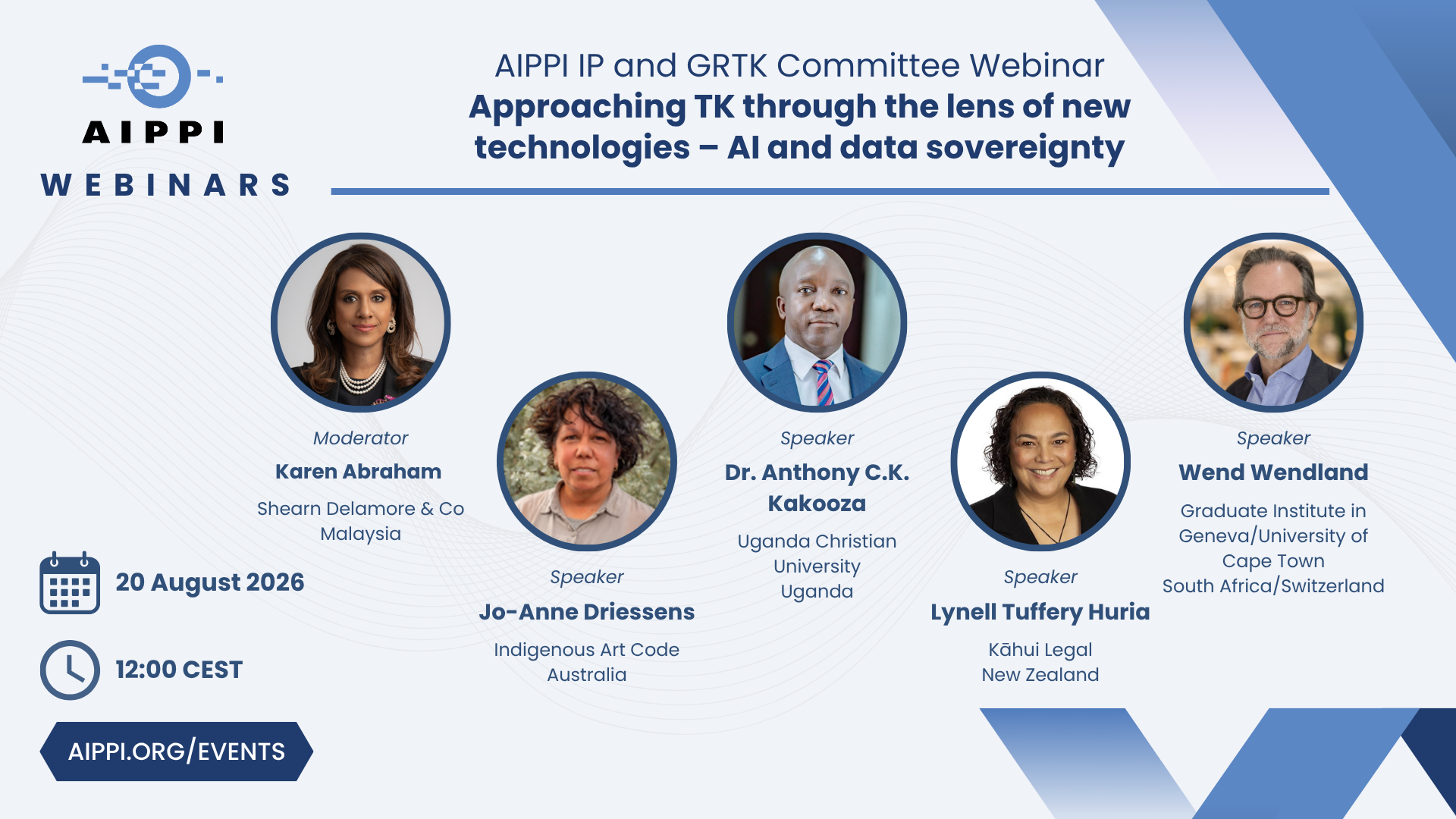
As the Chair of the Standing Committee on IP & GRTK for AIPPI, Karen Abraham is delighted to invite you to join a distinguished panel of expert speakers:
- Wend Wendland, who will provide a brief update on relevant international developments, such as at WIPO;
- Lynell Tuffery Huria, who will describe the characteristics of good data governance frameworks designed by Maori in New Zealand/ Aotearoa;
- Dr. Anthony C.K. Kakaoza, who will unpack the special considerations that apply to TK documentation in Africa in the age of AI and data protection; and
- Jo-Anne Driessens, who will bring practical insights into how AI is affecting Aboriginal and Torres Strait Islander artists in Australia.
Bringing together policy and legal analysis, Indigenous perspectives, community-based examples and international developments, this multidisciplinary webinar will explore how the intellectual property system can strengthen Indigenous control and agency over traditional knowledge, cultures, languages and data in the digital age.
Do not miss this opportunity to hear leading experts discuss the evolving relationship between traditional knowledge, artificial intelligence and data sovereignty. We warmly welcome your participation.
Karen Abraham, Shearn Delamore & Co, Malaysia
Chair of the Standing Committee on IP & GRTK for AIPPI
Jo-Anne Driessens, Indigenous Art Code, Australia
Jo-Anne is a descendant of the Koa, Kuku Yalanji people (First Peoples Australia). Jo-Anne combines her 30-year professional career as both an artist (photographer) and a specialised arts worker focusing on the fundamentals that assist Aboriginal and Torres Strait Islander artists protective mechanisms for Traditional Cultural Expression and Traditional Knowledge often featured throughout the visual arts industry. Having worked at Arts Law Centre of Australia as Artist in the Black Coordinator 2022-2025, the role involved the Indigenous Caucus participation at the general Assembly WIPO 2022-2024, including the WIPO Treaty on Intellectual Property, Genetic Resources and Associated Traditional Knowledge May 24, 2024.
These skills have and continue to provide a holistic understanding for specialised projects including her current role with the Indigenous Art Code as Aboriginal and Torres Strait Islander Engagement and Artist Membership Coordinator, providing support towards fair, transparent and ethical trade with Aboriginal and Torres Strait Islander visual artists.
Dr. Anthony C.K. Kakooza, Uganda Christian University, Uganda
Dr. Anthony C.K. Kakooza is a Ugandan Intellectual Property Law Advocate and Of Counsel in the law firm of Byenkya, Kihika & Co. Advocates where he oversees the firm’s Intellectual Property practice. He is also a Visiting Professor teaching Intellectual Property Law in Folklore and Traditional Knowledge at the University of Illinois in the U.S and previously at Shandong University in China, Cornell Law School in the U.S and Masaryk University in the Czech Republic.
Dr. Kakooza also undertakes I.P consultancies for Uganda Registration Services Bureau (the Ugandan National IP office), Africa Regional Intellectual Property Organization (ARIPO) and the World Intellectual Property Organization (WIPO). He was a WIPO Consultant in drafting the Traditional Knowledge and Folklore Action Plans for Uganda and Malawi, and also recently advised the Ugandan government in its TK Documentation process.
Lynell Tuffery Huria, Kāhui Legal, New Zealand
Ko Taranaki te maunga, ko Tangahoe ko Waingongoro ko Waitotara ngā awa, ko Aotea te waka, ko Ngāti Ruanui, ko Ngāruahinerangi, ko Ngaa Rauru Kiitahi ngā iwi.
For over 30 years, Lynell is a commercial lawyer, but has advised on all aspects of trade mark protection, management and enforcement for sole traders, start-ups, whānau, hapū, and iwi organisations in New Zealand, and multinational companies across the globe.
Lynell is recognised as the first Māori patent attorney and regarded as one of New Zealand’s leading experts on indigenous intellectual property (IP) law in New Zealand and the Pacific. Lynell has also developed a broad commercial practice advising on entity establishment, trust law, and a wide range of commercial transactions.
She is a Past Chair of the Indigenous Rights Committee for the International Trademark Association. In 2018, she was a member of the organising team for the inaugural Ngā Taonga Tuku Iho conference.
Wend Wendland, Graduate Institute in Geneva / University of Cape Town, South Africa / Switzerland
Wend Wendland has more than 30 years’ experience in intellectual property, in both the private and public sectors. He was a Director of the World Intellectual Property Organization (WIPO) for many years until his retirement in June 2025. He was the Secretary of the WIPO Intergovernmental Committee on Intellectual Property, Genetic Resources and Folklore (the IGC). He is the author of The Journey to the WIPO Treaty on Genetic Resources and Associated Traditional Knowledge: Policy, Process and People (Edward Elgar, 2025).
Mr. Wendland is a Senior Fellow of the Geneva Centre on Knowledge Governance at the Graduate Institute in Geneva and an Adjunct Professor, Faculty of Law, University of Cape Town, South Africa.
He was born in Cape Town and resides in the Geneva area, Switzerland.