A European electronic priority document? Absurdly elaborate, surprisingly useful
16 Sep 2026 | Newsletter

From paper logistics to portable electronic evidence
A priority document answers two deceptively simple questions: when was an application filed, and what did it contain on that date? For decades, the answer travelled on paper. The EPO sent a certified copy by conventional post to the applicant or representative, who then had to forward it, often through local agents and another postal or courier chain, to the WIPO International Bureau or to national and regional offices of second filing.
WIPO’s Digital Access Service (DAS) has removed much of that friction. A participating office of first filing makes the document available, and a participating office of second filing retrieves it using the applicant’s access code. But participation is voluntary and office-specific: not every office is connected, and participating offices do not necessarily support the same rights or functions.[1]
The EPO’s electronic priority document is therefore a useful complement to DAS. It gives the applicant a portable, digitally certified file for routes in which DAS cannot be used, as well as a verifiable copy for the applicant’s own records. Compared with the old paper chain, that is a major practical improvement.
What the EPO actually sends
Since 2025, the EPO has issued certified priority documents electronically through the MyEPO Mailbox. A request made through MyEPO is currently free of charge.[2] The delivery itself is less minimalist.
The outer transmission archive contains EPO Form 2517 and an archive called certified-copy.zip. Inside that archive are signature.pdf and a second file also called certified-copy.zip. The latter is the substantive archive: it contains priority_documents.pdf and toc.xml. Figure 1 shows the resulting bureaucratic nesting doll.
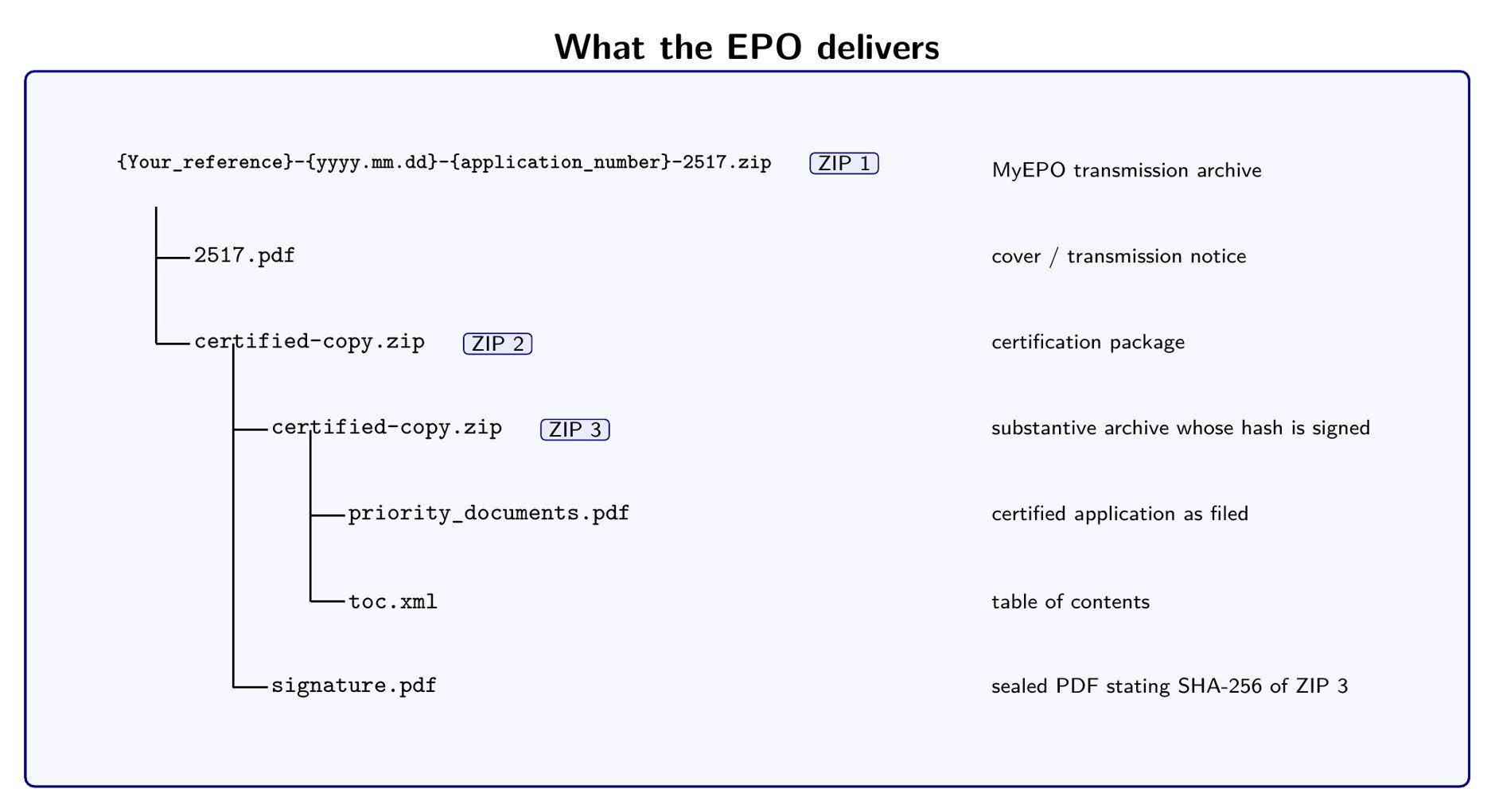
Figure 1. What the EPO delivers: three ZIP levels, two files named certified-copy.zip, a transmission notice, a certification PDF and the certified application content.
The outer filename follows the pattern:
{Your_reference}-{yyyy.mm.dd}-{EP_application_number_without_check_digit}-2517.zip
The date is the request date shown in Form 2517, while 2517 is the form number. The form is a cover notice, not part of the certified application content.
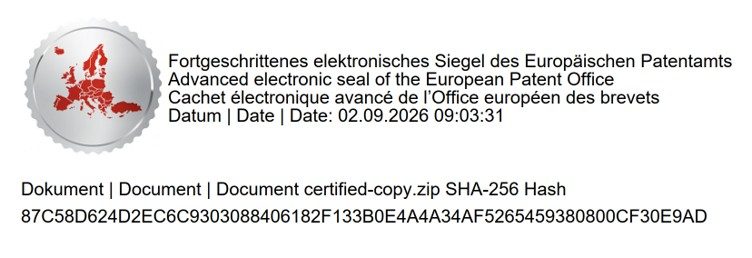
The separate signature.pdf identifies the application and filing date, states the SHA-256 digest of the inner substantive ZIP and carries the EPO’s advanced electronic seal.[3] As Figure 2 shows, the seal appears at the top, while the digest is printed separately below the multilingual label for certified-copy.zip. That value can be compared with a digest calculated locally over the inner ZIP.
Figure 2. How signature.pdf presents the advanced EPO seal and, separately, the SHA-256 value for the inner certified-copy.zip.
Principle of verification
Verification requires two linked checks. First, open signature.pdf in a PDF signature validator and validate the embedded EPO electronic seal. A successful validation confirms both that the certification PDF was issued by the EPO and that it has not been altered. For example, pyHanko can perform this check with pyhanko sign adesverify –eutl-all –pretty-print signature.pdf.[4]
Second, calculate SHA-256 over the inner certified-copy.zip – not the outer archive with the same name. On Windows, use certutil -hashfile .\certified-copy.zip SHA256; on Linux, sha256sum ./certified-copy.zip; and on macOS, shasum -a 256 ./certified-copy.zip. Compare the result with the digest printed in signature.pdf. If the values match, the sealed certification is bound to that exact archive and any alteration would be detectable.
The inner archive can then be opened and priority_documents.pdf inspected to confirm the application number, filing date and application content as filed.
Laugh at the packaging, keep the result
Could this be done more simply? Certainly. The Polish Patent Office, for example, creates one priority document by removing the abstract from the specification as filed, adding a first page with the data needed to establish the priority date and entitlement, and applying an eIDAS-compliant electronic seal. There is a fee, however,[5] and a separate request must be filed – it used to be a checkbox, but apparently that was too easy.
The EPO package is easier to parody: three archive levels, repeated filenames, a cover PDF, a certification PDF, a seal and a hash before one reaches the application itself. Yet it works, it is useful, and it takes only a couple of clicks to request through MyEPO. DAS remains the simplest route where it is available; the downloadable package covers the remaining routes and gives the applicant an independently verifiable record.
The packaging may be absurdly elaborate, but the result is a substantial improvement over certified paper travelling between the EPO, the applicant, WIPO and foreign offices. It proves, with unusual thoroughness, exactly when and what was filed. Whether what was filed is enough to support a later claim to priority is a different question.
[1] WIPO, Digital Access Service and participating offices.
[2] EPO, Notice concerning the issuing of electronic priority documents, OJ EPO 2025, A7, points 3 and 6.
[3] EPO, Technical specifications for electronic priority documents, OJ EPO 2025, A8.
[4] pyHanko, Validating PDF signatures. For the hash commands, see Microsoft certutil, GNU sha256sum and Apple shasum.
[5] Polish Patent Office, electronic priority documents and official fee table, item 8.