Recent Turkish Court of Cassation Ruling on the Distinctiveness and Descriptiveness of a 3D Trademark Application Involving a Whisky Glass Shape
16 Sep 2026 | Newsletter


The registration of 3D trademarks is ever challenging in Türkiye, as in many other jurisdictions due to the high threshold applied in assessing their distinctiveness and descriptiveness.
In this context, a recent decision of the Turkish Court of Cassation constitutes an important precedent on the assessment of distinctiveness and descriptiveness of 3D trademarks, particularly with regard to the goods covered by the application, relevant market realities, and verbal elements forming part of the mark, even where such elements are presented in a small size.
A- Administrative stage before the TÜRKPATENT
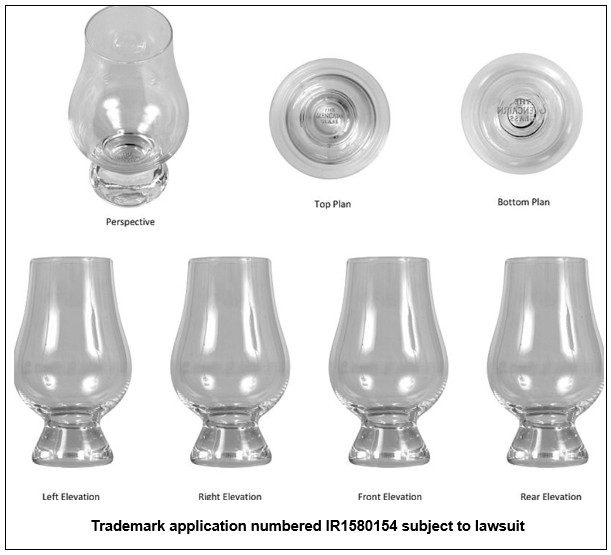
The applicant, filed a three-dimensional trademark application before the TÜRKPATENT, involving a glass shape for “Glassware; glasses; whisky glasses; whisky tasting glasses; whisky nosing glasses.” in Class 21. The application primarily consists of the shape of the glass and also includes the wording “The Glencairn Glass”, which appears in very small lettering at the bottom of the glass.
The trademark application was ex-officio rejected based on Article 5/1(b) and Article 5/1(c) on the grounds of lack of distinctiveness and descpritiveness.
The applicant filed an appeal against the ex-officio refusal decision before the Re-examination and Evaluation Board (“REEB”), arguing that the trademark was inherently distinctive and, in any event, had acquired distinctiveness through use, and therefore should not be refused on the grounds of lack of distinctiveness and descriptiveness.
The REEB decided to uphold the ex-officio refusal decision and rejected the applicant’s appeal. In its decision, the REEB concluded that although the 3D trademark application contained the verbal element, “The Glencairn Glass”, it was written in a very small size, and the main element that is intended to be protected with the application is the glass shape, rather than the word element. Accordingly, the REEB maintained its position that, when assessed as a whole, the trademark lacked distinctive character and was descriptive in relation to the relevant goods.
B- Court’s Decision:
The applicant filed a lawsuit requesting the cancellation of the REEB’s decision.
In the lawsuit, the plaintiff again argued that the 3D trademark application subject to lawsuit was inherently distinctive, as the shape of the glass differs significantly from common whisky glasses and also has a verbal element on its bottom. The plaintiff further argued that, in any event, the trademark had acquired distinctiveness through extensive use and was recognized by the relevant consumers as identifying the commercial origin of the goods.
In support of these arguments, the plaintiff submitted several pieces of evidence comparing the trademark application subject to lawsuit with common whisky glasses, demonstrating that the verbal element on the bottom of the glass shape is readable and that consumers know that the shape of the glass belongs to the plaintiff.
The expert report received during the first instance court was supporting the REEB’s decision, and was unfavourable to the applicant/plaintiff.
Despite the experts’ report with the findings on the contrary, the first instance court accepted the applicant/plaintiff’s lawsuit and annulled the REEB’s decision.
In its decision, the first instance court highlighted that, when evaluating the distinctiveness and descriptiveness of a trademark, the relationship between the sign and the goods and services within its scope should be taken into account. The Court noted that the trademark application subject to lawsuit involved a glass shape whose mouth narrowed upwards, widened towards the bottom at a particular angle, and became convex, with a bottom that expanded downwards. The Court found that these features distinguished the glass from customary whisky glasses available on the market.
Moreover, the Court remarked that the trademark application subject to lawsuit involved the phrase “THE GLENCAIRN GLASS” on its bottom. Contrary to the REEB’s conclusion, the Court noted that it was evident that the 3D trademark application subject to lawsuit sought protection together with the verbal element, which imparted distinctiveness to the mark. Although this phrase was written in a small size and placed at the base of the glass, the Court highlighted that placing word elements in this manner is customary for such products and that the verbal element would be visible in the normal course of use. Furthermore, the Court added that since the trademark application consists of both the device and “The Glencairn Glass”, it is not descriptive either.
The first instance court’s decision was subsequently upheld by both the Regional Court of Justice and the Court of Cassation.[1]
This Court decision remarks that, although the registration of 3D trademarks is subject to a higher threshold of distinctiveness, each case must be assessed in light of the goods covered by the trademark and the market realities relating to those goods.
A small-sized verbal element may not be sufficient to impart distinctiveness to certain goods, while it may do so for others, depending on the relevant market realities. Likewise, when assessing the distinctiveness of 3D marks, particular scrutiny must be given to whether the 3D trademark differs from other shapes commonly used for similar goods and whether consumers would perceive the 3D shape as a trademark originating from a particular undertaking or not.
[1] Yargıtay 11.Hukuk Dairesi, 26.02.2026 T., 2025/4037 E., 2026/1129 K.